INTRODUCTION
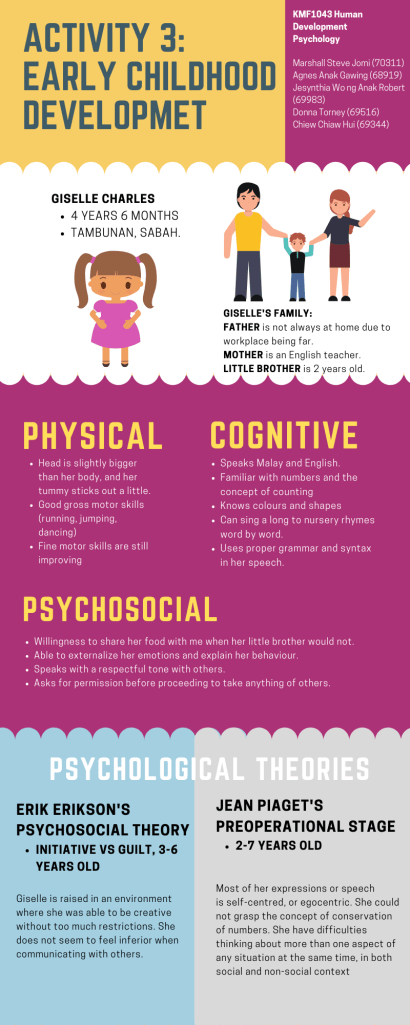
For this activity, we have decided to observe one of our team member (Donna)’s little cousin, Giselle Charles. She was born on 23rd December 2016, so she is 4 years and 6 months. She was born in Tambunan, Sabah which is a small town that is 2 hours away from the big city. Her mother is an English teacher in Tambunan, and her father works with SESB in the city, so he only comes home on the weekends. She also has a 2 year old brother.
OBSERVATION
Since our subject is a family member, the activity was carried out as how I (Donna) would play with her at her home so she would feel comfortable. I also observed and analysed her over a few days and recall other significant events that would help explain or help with our analysis about the development of children in the early childhood phase. We observed the three dimensions of early childhood development; physical, cognitive and psychosocial.
- Physical
Like other kids her age, her head to body ratio is not proportionate. Her head is slightly bigger than her body, and her stomach sticks out just a bit. She has good gross motor skills; she can run, though not as fast or as balanced as the older kids; she knows how to use a fork and a spoon. I did some painting and drawing with her, and she was very gentle as to not press too hard on the solid watercolour when I asked her to be careful. She still does not have great fine motor skills where she can map out a distinct feature of objects or faces; most of the time they were random.
- Cognitive
To observe her cognitive development, I asked her to count, name colours and basic shapes, and we sang nursery rhymes. She did not have any trouble doing any of it. She is familiar with colours and can count numbers up to 20 in both English and Malay, and she knows the alphabet. She memorized nursery rhymes and can sing them. She also figured out that you should wet your brush before dipping into solid watercolours. She also uses proper grammar and syntax in her speech.
I tested her conservation, following an experiment we found on the internet. On a piece of paper, I painted two groups of dots. Group A, I painted 20 small circles close to each other; group B, I painted 20 small circles far from one another. I then asked her which group has more dots, and she said that group B has more dots.
- Psychosocial
One of the ways I did to observe her psychosocial development was her willingness to share. I gave her and her two-year-old brother some snacks in separate packets; both of them on either of my sides. I asked her brother to give me a snack, but he was not willing to share. Upon seeing that, Giselle reached into her packet and gave me some snack. Unlike her brother, she was willing to share even when I did not ask her.
During our painting activity, I drew a line dividing the paper into two columns. I asked her to paint using only yellow in one column because I like the colour yellow and that she should not mix it with any other colour, and she can use purple (which is her favourite colour) on the other column. She did actually paint the other column yellow, but when she dipped into purple, she painted the whole paper in it.
ANALYSIS
According to our observations, Giselle’s development seems to be where she should be at this stage of her life. According to Jean Piaget’s pre-operational stage which occurs from age 3-7, he stated that oftentimes see kids at the beginning of this stage that participates in simultaneous play; they often play in the same room as other people, but play alongside them instead of with them. This is true of Giselle when playing with her brother or my other cousins sometimes. It seemed that they are in their own private world, and most of their expressions or speech is self-centred, or egocentric.
The main purpose of speech at this stage is to outwardly express their thoughts, rather than to communicate with others. Children my cousin’s age (2-7) has not yet able to fully grasp social situations. Egocentrism and centrism can probably explain why she was not able to follow through with when I asked her to only colour one column of the paper yellow (my favourite colour), and the other with purple (her favourite colour). She was also not able to focus on me while she was painting.
Another theory is ‘Initiative vs Guilt’ which is the third stage of psychosocial development theory by Erik Erikson. This stage takes place in the preschool years, between the ages of 3 and 5. It is at this stage that as his appetite for knowledge increases, the child will begin to ask lot of question. When the parents view the concerns of the child as irrelevant, irritating or humiliating or certain elements of their actions as dangerous, the child may feel bad for “being a nuisance.” This would lead to guilt, and some self-esteem issues. Giselle asks a lot of questions every time I see her, about what the use of certain objects and WHYs and HOWs. On one of my cousin’s birthday, she would ask her mother for permission before taking a cupcake from the table. According to Erikson, some guilt is needed; otherwise the child would not learn how to maintain self-control or have a conscience. Success in initiative lead to the child being able to exercise her creativity, and I think this is true of Giselle’s case.
. Social learning or psychosocial is at the center of the children’s ability to get along with other people and to see things from their perspective. The basis of this essential skill rests in the development of theory of mind. “Theory of mind” relates to our perception of other individuals having their own mental states – such as beliefs, intents, desires, emotions, knowledge, etc. We use theory of mind to explain our own behaviour to others by telling them what we think and want, and by interpreting other people’s behaviour and how they talk and considering them before acting on it. According to Lowry (n.d), between ages 4-5, children really start to think about others’ thoughts and feelings, and this is when true theory of mind emerges. This explains Giselle’s willingness to share, when envy is not present (i.e when playing and having to share toys with her brother).
Another theory is child development behavioural theories that focus on how environmental experience influences behaviour, and are based on theories by psychologists including John B. Watson, Ivan Pavlov, and B. Skinner, F. Such theories only deal with observed behaviours. Development is seen as a response to rewards, penalties, motivation, and reinforcement. Giselle’s family are really responsive when she guesses things correctly, and gives great response to the things she says and does.
.
CONCLUSION
All in all, every dimensions of early childhood development correlates with one theory to another. Giselle fits the physical checklist of a typical 4 year old, and her cognitive abilities fits a typical 4-5 year old child; ability to speak in a manner that is not hard to understand by a typical adult, to externalize her thoughts and needs, to be able to empathies with others, and to be able to exercise creativity and logic.
The development of early childhood focuses on a time of profound physical, cognitive, social, and emotional growth. Infants reach the world with limited abilities and skills. This development and transition occur at a rapid rate during the early years of childhood (3-6 years old), so rapid that adults still wonder at how quickly those abilities develop. Developmental psychology aims to understand and explain how individuals over their whole life cycle change and evolve. Scientists are researching the broad variety of causes, including how genetics affect the growth of a child and how interactions play a part.
REFERENCE
Astington, J. W. (2010). Social cognition: The Development of Theory of Mind in Early Childhood. Retrieved from http://www.child-encyclopedia.com/social-cognition/according-experts/development-theory-mind-early-childhood
Cherry, K. (2019, August 02). This Is How Children Develop a Sense of Initiative. Retrieved from https://www.verywellmind.com/initiative-versus-guilt-2795737
Lowry, L. (n.d.). “Tuning In” to Others: How Young Children Develop Theory of Mind. Retrieved from http://www.hanen.org/Helpful-Info/Articles/Tuning-In-to-Others-How-Young-Children-Develop.aspx
Mcleod, S. (n.d.). The Preoperational Stage of Cognitive Development. Retrieved June 28, 2020, from https://www.simplypsychology.org/preoperational.html
 KMF1043 Human Development Psychology Group 3